30 Shoe Ad Examples That Brands Kept Running on Meta
Checked 25 Oct 2026 · 30 ads from 15 brands, from Meta's Ad Library · How we pick ads
Comfort is the whole sale in footwear, and a photo cannot show how a shoe feels after a full day. So the ads that ran longest give the shopper something to check: a trip, a forecast, a part of the shoe or a named referee. Oliver Cabell's plain feet-on-turf photo reached 317 days, and Reef's "The Airport Sneaker" and Tropicfeel's every-trip reply ran 312 and 314.
- 317+days, the longest run
- 30%of ads are lifestyle shots with a person in them
- 20%of ads put a claim or badge on the picture itself
Making comfort checkable in one scroll
Grouped by the job each ad does. Swipe a row, and tap “Why it works” for our breakdown.
Built for the trip, rain included · 6
Instead of arguing comfort, these ads give the shoe a place to go or a forecast to survive: Reef's "The Airport Sneaker" and Vessi's "Float over cobblestones" let the viewer picture the walk.
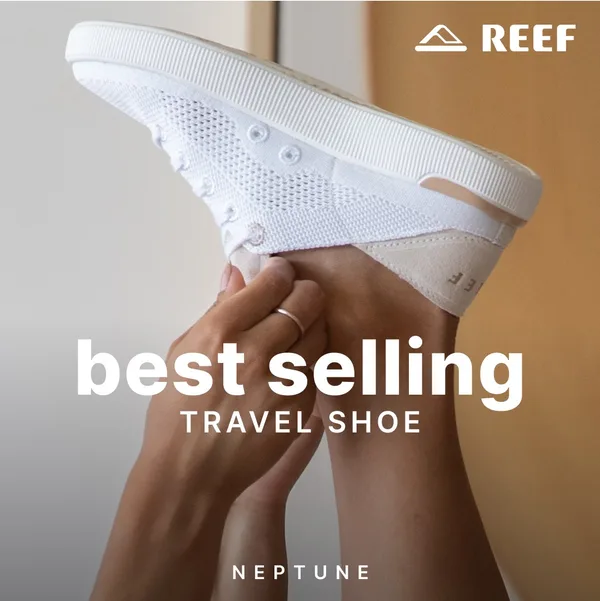
“The Airport Sneaker”
Why it works
A hand pulls a white knit sneaker off a raised foot, sole facing the lens, with "best selling TRAVEL SHOE" across the lower half. The angle shows the sole and the knit upper in one look, and the label gives the buyer a use before any feature. The headline names a place, not a material, which makes the shoe easy to picture on a trip. Neptune appears only as a small line at the foot of the frame, behind the use.
Started 17 Dec 2025. Live when checked on 25 Oct 2026. View in Meta Ad Library ↗
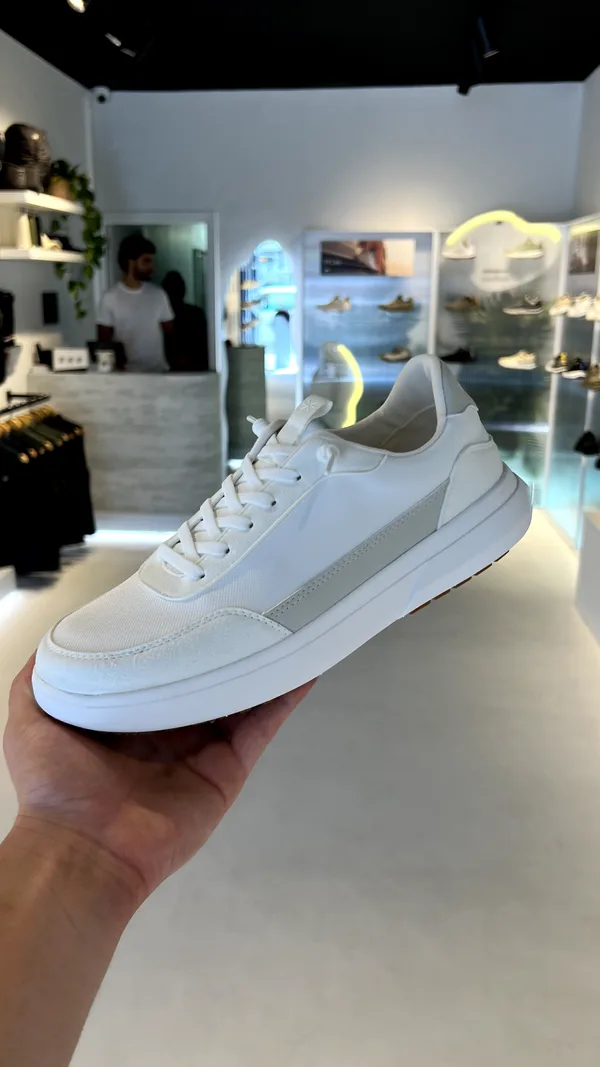
“Built for the city. Ready for adventure.”
Why it works
A hand holds a white sneaker toward the camera in a bright store, shelves of other shoes blurred behind it, shot like a phone video taken in the aisle. The framing lets a viewer inspect the shoe as if they had picked it up. Weather, the thing a bare product shot leaves out, arrives in the body as "rain or shine".
Started 17 Dec 2025. Live when checked on 25 Oct 2026. View in Meta Ad Library ↗
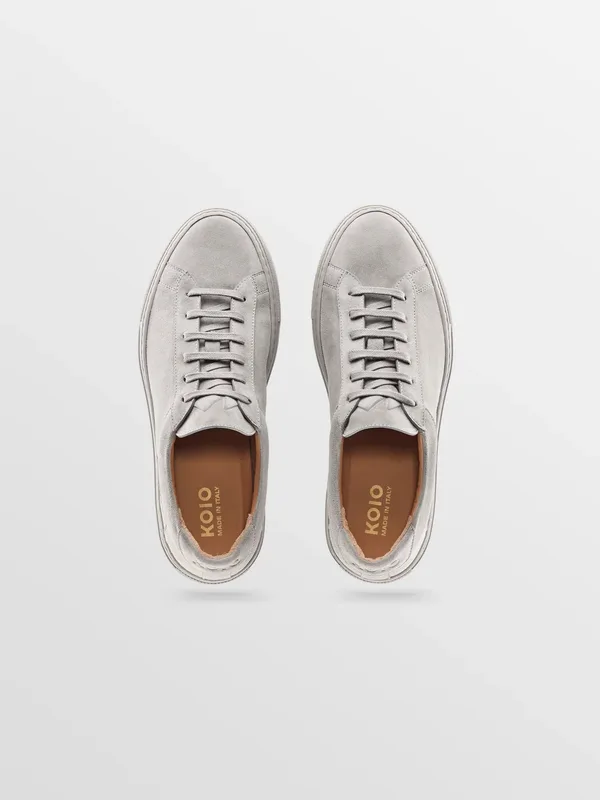
“Travel Sneaker of the Year”
Why it works
A pair of pale gray suede sneakers is shot from above on a plain background, with the Koio name printed on the tan lining. The picture is quiet on purpose, so the headline and the body's Forbes line do the persuading. A named publication turns a matter of taste into a short list. Italy is named in the body and the lining prints Made in Italy, so the origin claim stays inside the frame.
Started 29 Jan 2026. Live when checked on 25 Oct 2026. View in Meta Ad Library ↗
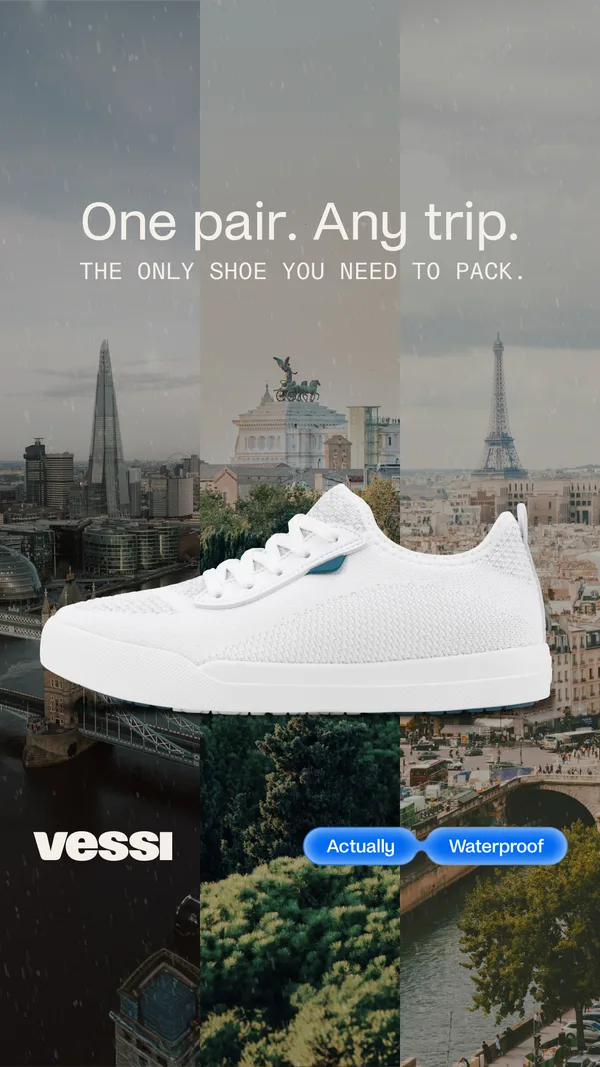
“Float over cobblestones”
Why it works
A white knit sneaker sits across three rainy city panels: a glass tower, a classical monument and a lattice tower. The on-image line says "One pair. Any trip." and "THE ONLY SHOE YOU NEED TO PACK.", with an "Actually Waterproof" pill in the corner. Each destination is a packing question the shoe answers, and the rain is drawn into the backdrop. A single product floating over all three panels makes the case for bringing one pair.
Started 1 Jul 2026. Live when checked on 25 Oct 2026. View in Meta Ad Library ↗
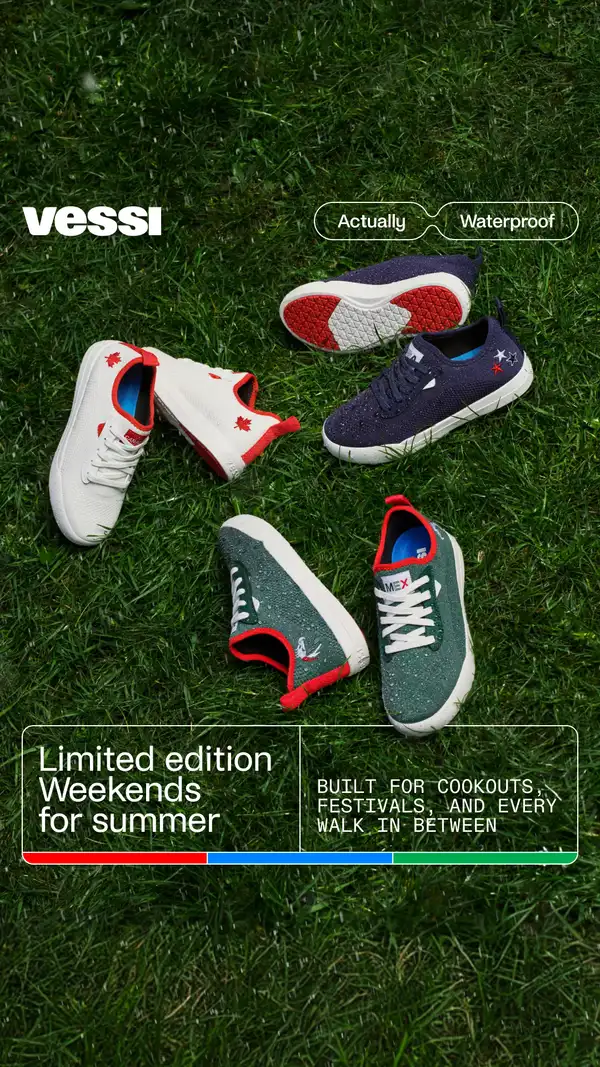
“BUILT FOR COOKOUTS, FESTIVALS, AND EVERY WALK IN BETWEEN”
Why it works
Waterproof comes out on a lawn: limited-edition knit sneakers in white, navy and green lie scattered on grass, with the "Actually Waterproof" pill at the top and a banner reading "Limited edition Weekends for summer" below. The designs are the news, and the waterproof pill is the reassurance a casual weekend shoe needs. Cookouts and festivals are named, so the waterproof claim is tied to specific weekend plans.
Started 1 Jul 2026. Live when checked on 25 Oct 2026. View in Meta Ad Library ↗
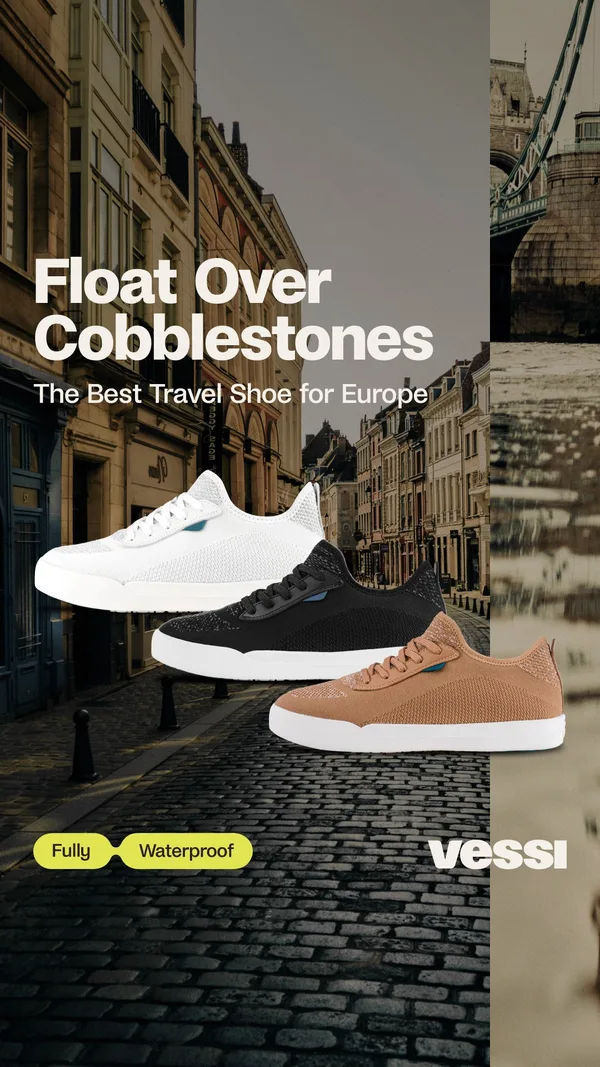
“Who likes wet socks?”
Why it works
Three colorways of a knit sneaker hover over a cobblestone street under "Float Over Cobblestones" and "The Best Travel Shoe for Europe", with a "Fully Waterproof" pill. The body asks "Who likes wet socks?" and offers a Dry Socks Promise, which stands behind the waterproof claim. Borrow the guarantee line when a claim needs a backstop.
Started 1 Jul 2026. Live when checked on 25 Oct 2026. View in Meta Ad Library ↗
Comfort spelled out part by part · 7
Oliver Cabell prints a benefit beside each part of the shoe, and VIVAIA's icons name the last, the sole and the upper, so the comfort claim becomes a list a shopper can tick off.
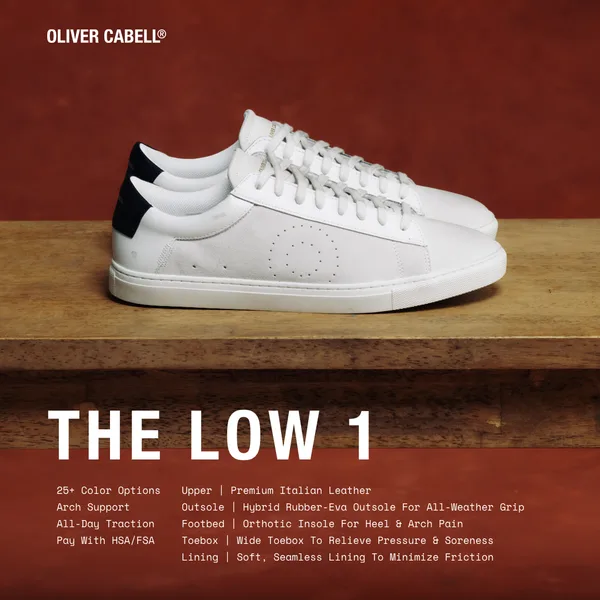
“Timeless Comfort. Season After Season.”
Why it works
The sneaker sits on a wooden shelf against a rust-red wall, and the lower third becomes a spec sheet: "Orthotic Insole For Heel & Arch Pain", "Wide Toebox To Relieve Pressure & Soreness", "All-Day Traction". Each part of the shoe is paired with the problem it answers, which is the nearest a photo gets to a fitting. A line about paying with HSA/FSA sits among the specs. Fit worries are answered part by part, inside the frame, before anyone clicks.
Started 2 Jan 2026. Live when checked on 25 Oct 2026. View in Meta Ad Library ↗
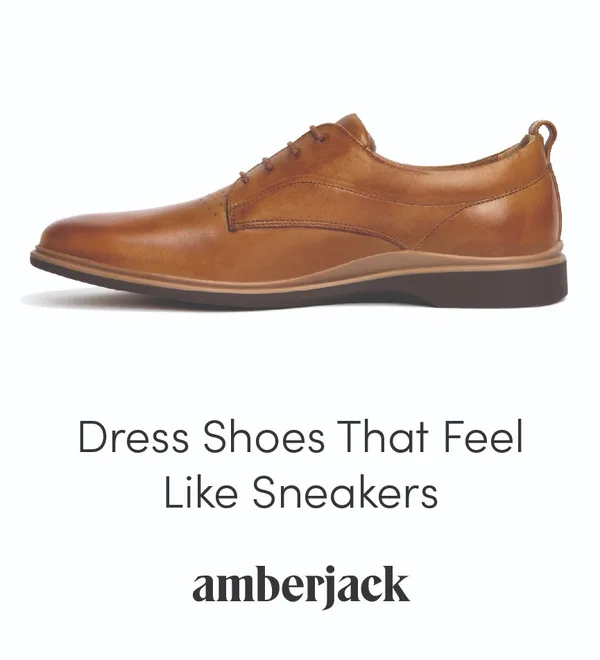
“World's Most Comfortable Dress Shoes”
Why it works
A tan leather derby in profile sits on white above a short promise: "Dress Shoes That Feel Like Sneakers." Dress shoes carry a name for stiffness, and the line borrows the comfort shoppers already trust from sneakers to cancel it. In the body, a Pro Tip says not to sacrifice comfort for style. Nothing else is on the page but the amberjack wordmark, so the comparison has the whole frame to itself.
Started 24 Mar 2026. Live when checked on 25 Oct 2026. View in Meta Ad Library ↗
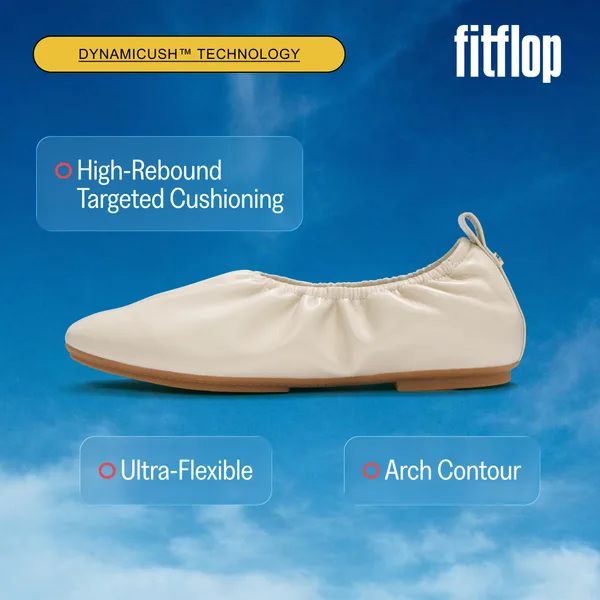
“flats that don't make you miss your sneakers”
Why it works
A cream ruched ballet flat floats on a blue sky, ringed by glassy callouts: "High-Rebound Targeted Cushioning", "Ultra-Flexible", "Arch Contour". The sky says light and the callouts say supportive, which is the contradiction a flat has to settle. The body states the same trade in a sentence, "flats that don't make you miss your sneakers". SHARE15 in the headline adds a price reason beside the comfort reasons.
Started 25 Jun 2026. Live when checked on 25 Oct 2026. View in Meta Ad Library ↗
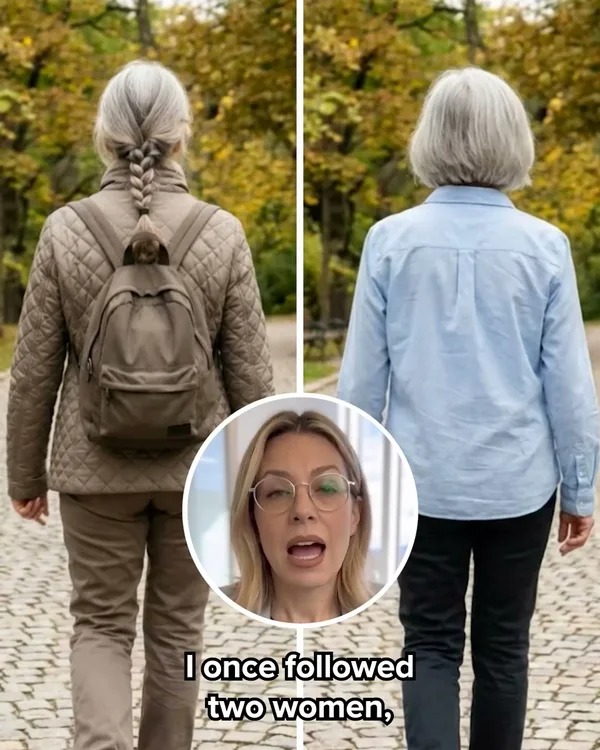
“I once followed two women,”
Why it works
Two women are seen from behind on a cobbled park path, one in a quilted jacket with a backpack and one in a blue shirt, split by a talking-head circle and the subtitle "I once followed two women,". The body ticks off features: "No pressure points", "High-grip outsole" and a wide toe box. Walking is the picture's subject, and the shoe's job is spelled out in the body.
Started 3 Aug 2026. Live when checked on 25 Oct 2026. View in Meta Ad Library ↗
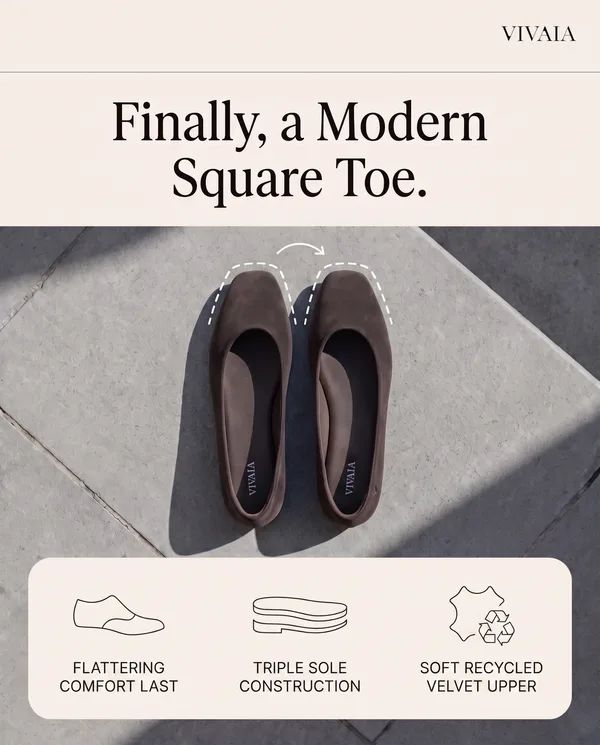
“Finally, a Modern Square Toe.”
Why it works
A top-down pair of brown velvet flats rests on a stone slab with dashed outlines tracing the square toe, and three icons below name the comfort last, the triple sole and the recycled velvet upper. The headline, "Finally, a Modern Square Toe.", frames the problem as a shape. Try dashed outlines when the shape is the news.
Started 12 Sep 2026. Live when checked on 25 Oct 2026. View in Meta Ad Library ↗
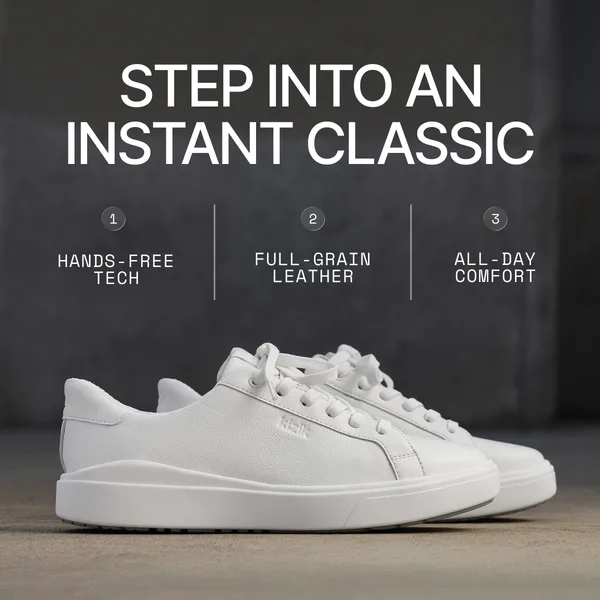
“Go hands-free with the best”
Why it works
A white leather sneaker sits on a concrete floor under "STEP INTO AN INSTANT CLASSIC" and three numbered columns: hands-free tech, full-grain leather, all-day comfort. Hands-free is the one claim a still photo can't show, and it takes the first slot, ahead of leather and comfort. Hands-free is repeated in the headline, "Go hands-free with the best".
Started 22 Sep 2026. Live when checked on 25 Oct 2026. View in Meta Ad Library ↗
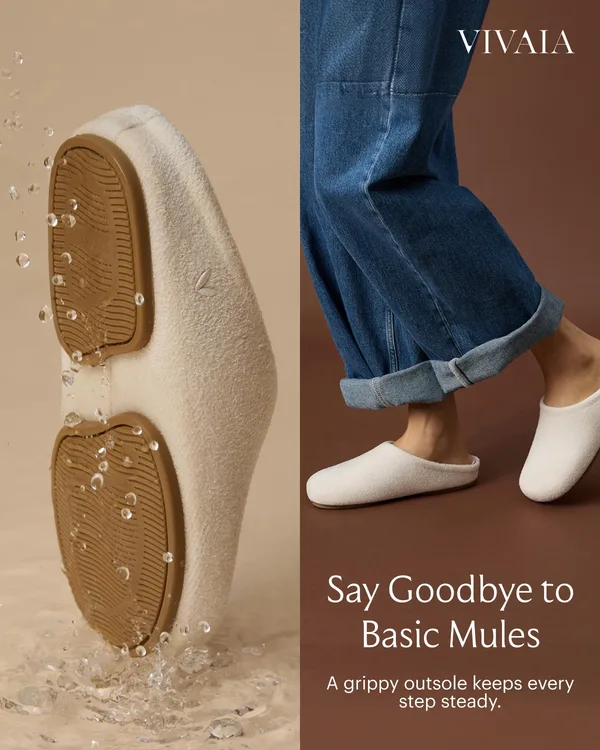
“More Grip. Less Guesswork.”
Why it works
A split frame puts a macro of a cream mule's gripped sole in a splash of water on the left and a person in rolled jeans wearing the same mules on the right, under "Say Goodbye to Basic Mules." The body is first-person: "I used to save my mules for perfectly dry days." The splash is the demo and the on-foot view is the context. Grip is shown with water instead of told.
Started 25 Sep 2026. Live when checked on 25 Oct 2026. View in Meta Ad Library ↗
A badge or review count vouches · 5
Koio's press bar and Amberjack's Forbes quote borrow a stranger's judgment, while Sole Bliss carries its review count and award line in the body of two different pictures.
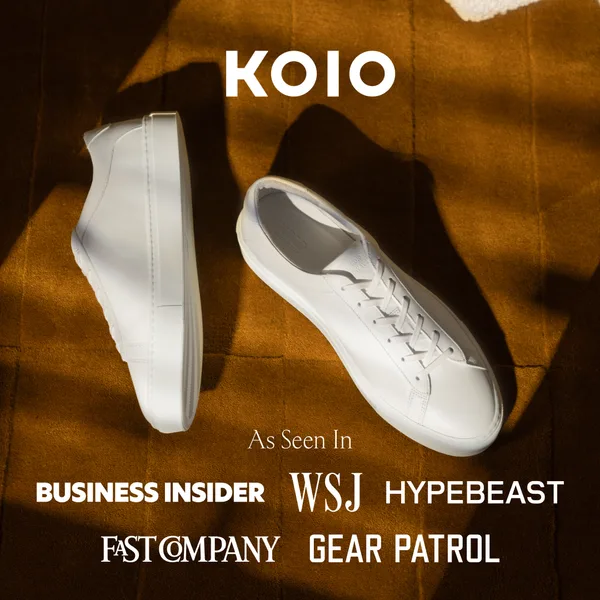
“Meet your new favorite sneaker.”
Why it works
Two white sneakers lie on a sunlit golden-brown cloth under the Koio name, and a bar of press logos (Business Insider, WSJ, Hypebeast, Fast Company, Gear Patrol) fills the bottom. The body adds a verified customer saying they have worn the pair almost daily for a year. Together the logos and the quote cover two doubts: whether experts like the shoe and whether it lasts. Experts first and a wearer second is the order built into this frame.
Started 20 Feb 2026. Live when checked on 25 Oct 2026. View in Meta Ad Library ↗
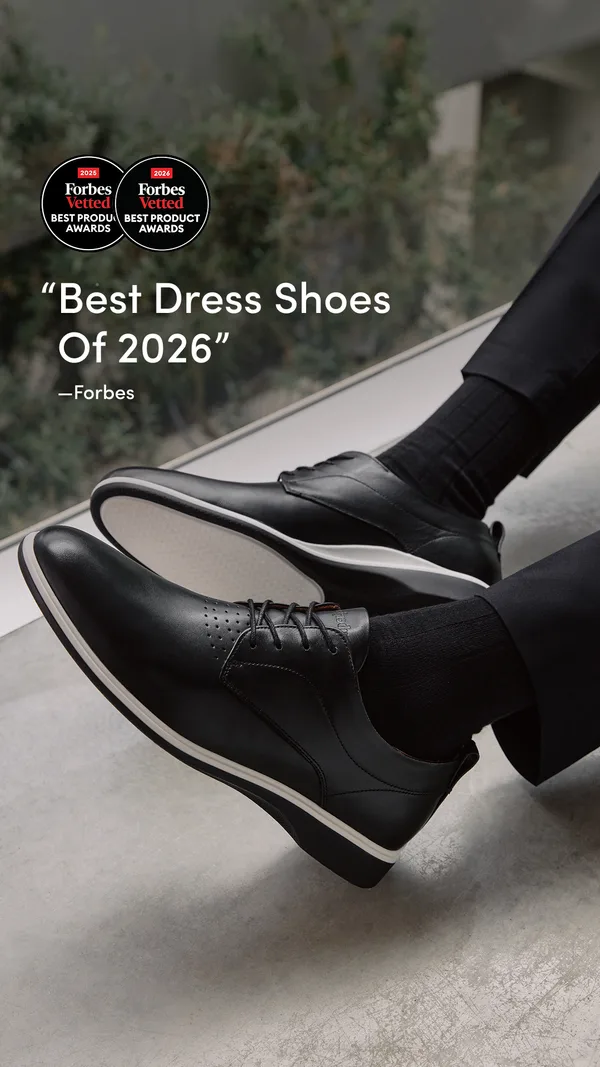
“Don’t call it a comeback.”
Why it works
Two Forbes Vetted badges and a Forbes quote naming the best dress shoes sit over a close shot of black lace-ups crossed at the ankle, with dark pants and socks. The headline plays on a comeback, and the body adds "AGAIN", so one award reads as a streak. The crossed pose turns one sole to the camera, so shape and sole show in a single frame. Badges come first and the shoe second, so the vouching happens before the eye reaches the leather.
Started 24 Mar 2026. Live when checked on 25 Oct 2026. View in Meta Ad Library ↗
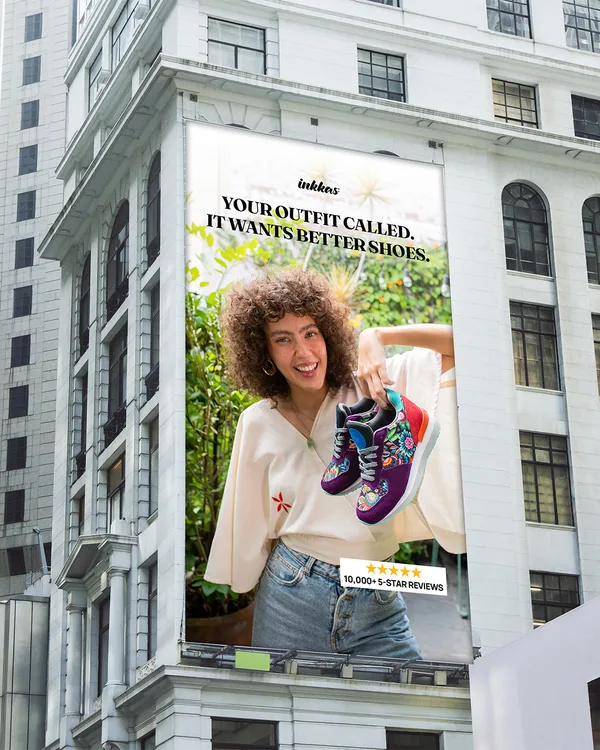
“YOUR OUTFIT CALLED. IT WANTS BETTER SHOES.”
Why it works
A billboard-style banner on a city building shows a smiling woman holding a printed sneaker, under the headline "YOUR OUTFIT CALLED. IT WANTS BETTER SHOES." and a badge reading "10,000+ 5-STAR REVIEWS". The out-of-home mock-up gives a shoe brand the scale of a street advertiser, and the review badge sits low in the banner where the eye lands after the face. Humor in the headline and a number in the badge each do a separate job.
Started 14 Sep 2026. Live when checked on 25 Oct 2026. View in Meta Ad Library ↗
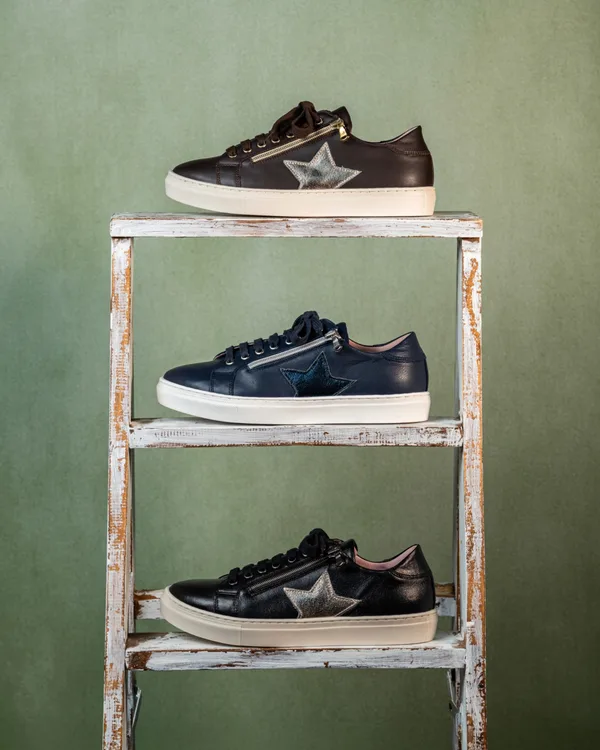
“Discover Luxuriously Comfortable Shoes for Bunions, Wide Feet and Sensitive Soles.”
Why it works
Three leather sneakers with star details sit one to a rung on a whitewashed wooden ladder against a green wall. The picture is calm and carries no text, so the body does the selling, naming "Bunions, Wide Feet and Sensitive Soles" up front and then "FREE Shipping & FREE Returns" and "over 4,000 5-Star Reviews". Free returns sit beside the condition, which answers the fit risk where it is raised.
Started 14 Sep 2026. Live when checked on 25 Oct 2026. View in Meta Ad Library ↗
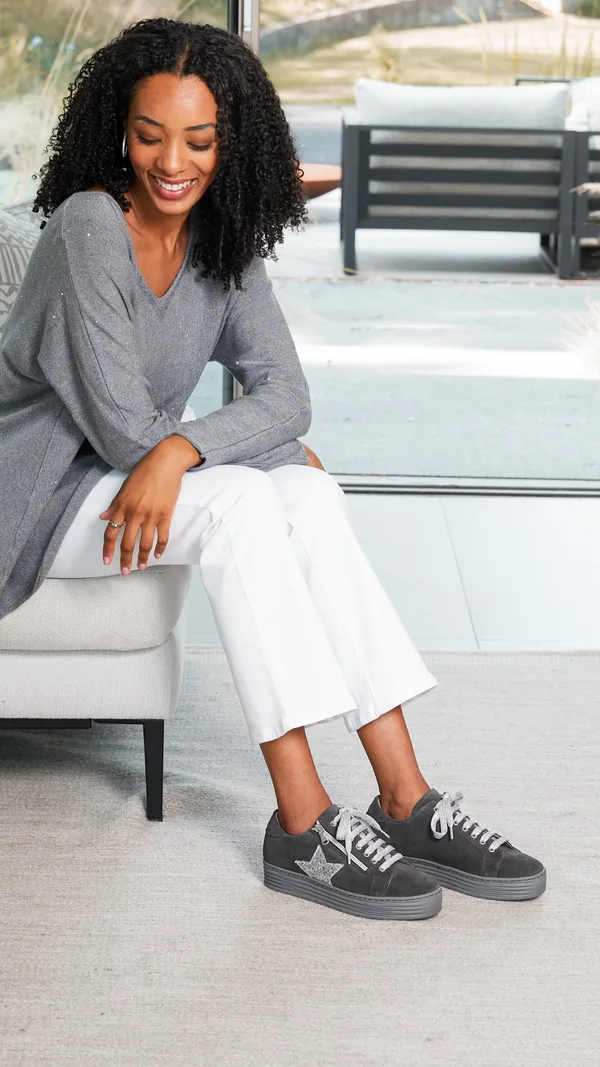
“Loved by Celebs and Royalty.”
Why it works
A woman in a gray knit and white pants sits on a cream armchair and looks down at dark platform sneakers with a star on the side, glass doors behind her. It is a worn shot that shows how the shoe sits under a full-length pant. The body is the same as the ladder ad and carries "Winner of The King's Award" and the code WELCOME10. Shared copy across both pictures leaves the picture as the only thing that changes.
Started 14 Sep 2026. Live when checked on 25 Oct 2026. View in Meta Ad Library ↗
Boots lined up by model name · 3
Thursday Boot Company's labeled lineups let a buyer choose a silhouette from a range in one glance, with a model name beside every boot.
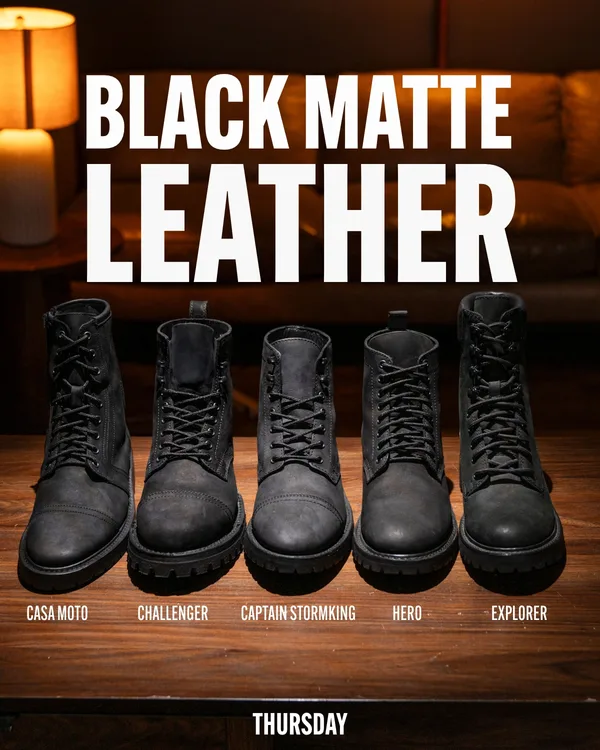
“Black Matte Leather”
Why it works
A row of black matte boots stands on a wooden table in a lamplit living room under "BLACK MATTE LEATHER" in huge type, each with its model name underneath. The room says everyday wear, the body says "Designed for All-Day Comfort", and the row says range. Names like Casa Moto and Captain Stormking let a buyer pick by name instead of squinting at silhouettes. One finish holds the set together, which keeps the choice about shape.
Started 7 Apr 2026. Live when checked on 25 Oct 2026. View in Meta Ad Library ↗
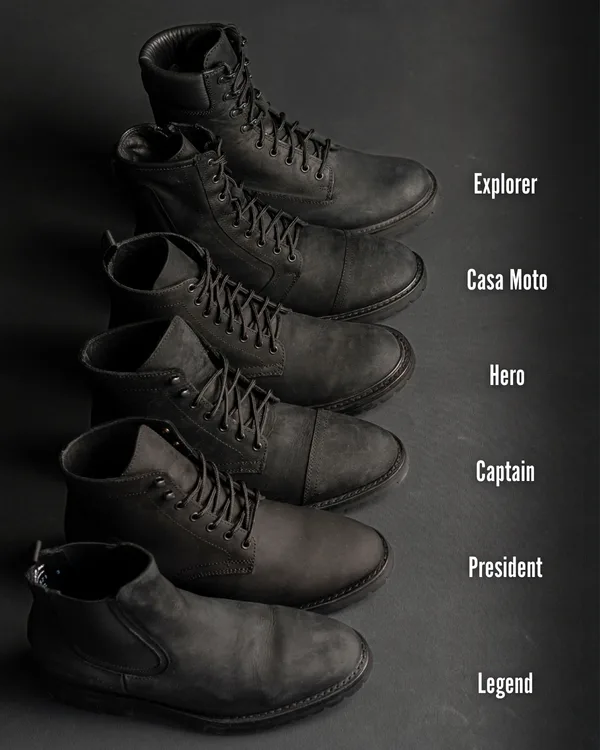
“125,000+ 5-Star Reviews”
Why it works
A diagonal run of dark boots sits on a black ground with model names stacked down the right edge, from Explorer to Legend. The headline carries "★★★★★ 125,000+ 5-Star Reviews", which leaves the image free to work as a catalog page. The moody monochrome lighting makes the boots look alike, so the labels do the sorting. Returns sit in the body, close to the review count.
Started 7 Apr 2026. Live when checked on 25 Oct 2026. View in Meta Ad Library ↗
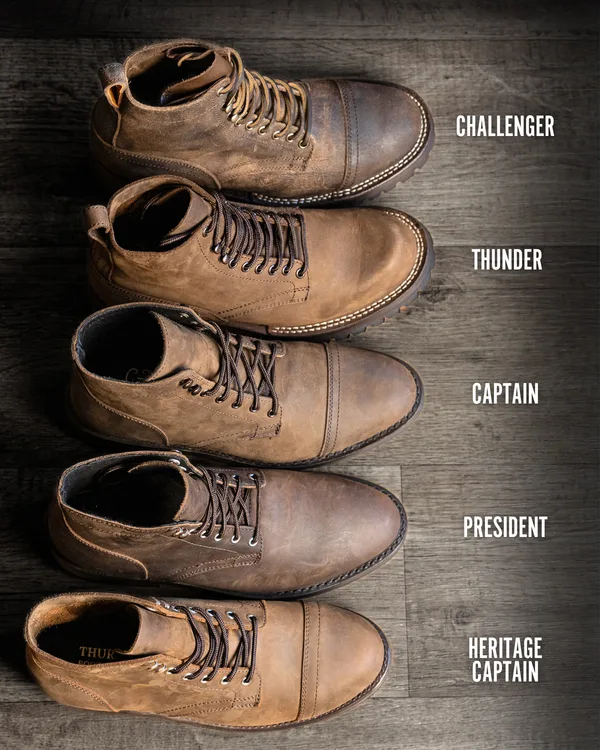
“Tobacco Leather Collection”
Why it works
Brown leather boots are stacked from top to bottom on gray wood boards, each with a bold model name at the right edge, from Challenger to Heritage Captain. The warm tan of the leather is the only color in the picture, so the eye compares toe caps and stitching instead of backgrounds. Price gets a reason too, because the body promises boots, sneakers and dress shoes at "the lowest sustainable markup possible".
Started 7 Apr 2026. Live when checked on 25 Oct 2026. View in Meta Ad Library ↗
Borrowed phone screens · 3
Tropicfeel's comment reply and Inkkas's AirDrop prompt dress the ad as something the viewer already trusts or taps, and the comfort claim rides inside the reply or the joke.
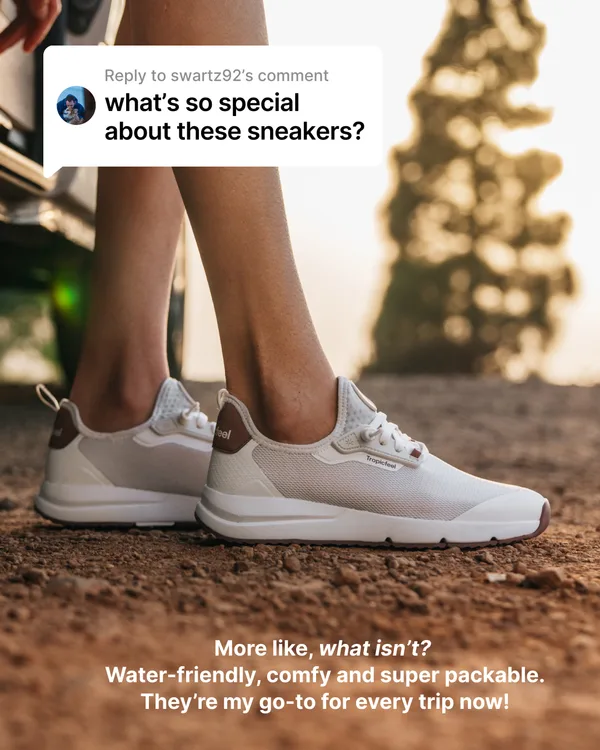
“Water-friendly, comfy and super packable.”
Why it works
A reply sticker asks "what's so special about these sneakers?" over a low shot of white sneakers on dirt, and the answer is typed underneath. The format copies a short-video comment reply, so the claim lands as a fan's answer rather than a brand slogan, and three travel traits fit in one line. It ran 314 days under the headline "Season's End Specials", with up to 30% off in the body.
Started 15 Dec 2025. Live when checked on 25 Oct 2026. View in Meta Ad Library ↗
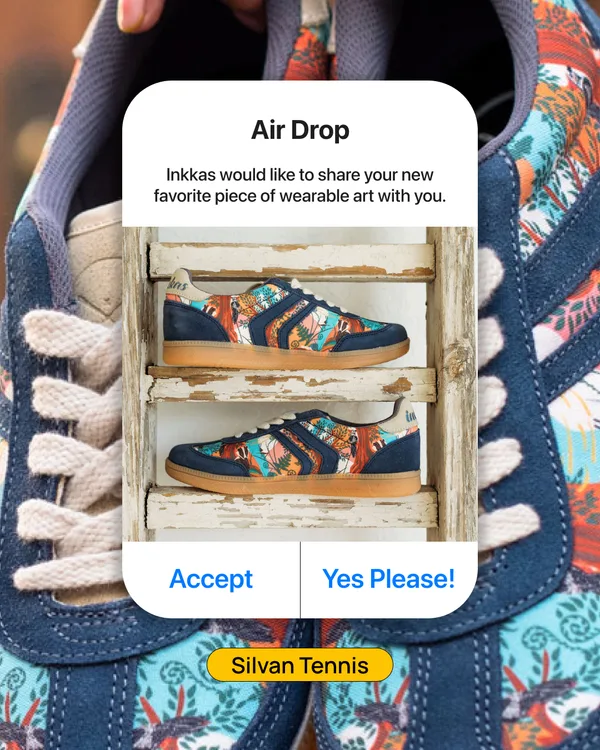
“Inkkas would like to share your new favorite piece of wearable art with you.”
Why it works
A phone notification fills the frame: "Air Drop", a line saying Inkkas wants to share "your new favorite piece of wearable art", and Accept and Yes Please buttons over a macro of a printed sneaker. The familiar prompt stops a scroll, and the cheerful Yes Please button makes both answers a yes. Inside the card, the shoe appears on a whitewashed shelf, with the Silvan Tennis name in a yellow pill below.
Started 14 Sep 2026. Live when checked on 25 Oct 2026. View in Meta Ad Library ↗
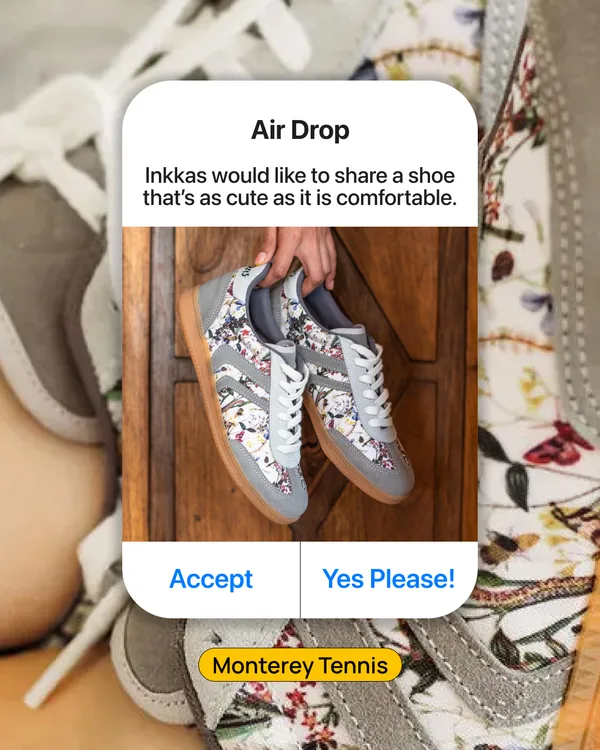
“Inkkas would like to share a shoe that's as cute as it is comfortable.”
Why it works
The AirDrop prompt returns, but the card now holds a hand lifting a floral sneaker with gray suede stripes, and the line promises "a shoe that's as cute as it is comfortable." A pill reads Monterey Tennis. The comfort promise is tucked inside the joke, so the claim lands as personality, not as a spec. Behind the card, a blurred macro of the same print fills the frame.
Started 14 Sep 2026. Live when checked on 25 Oct 2026. View in Meta Ad Library ↗
Shoe first, few words · 6
Oliver Cabell's feet-on-turf shot and CLAE's hand-held pair print almost no text, so taste and identity ride on the picture, and whatever comfort claim exists waits in the body copy.
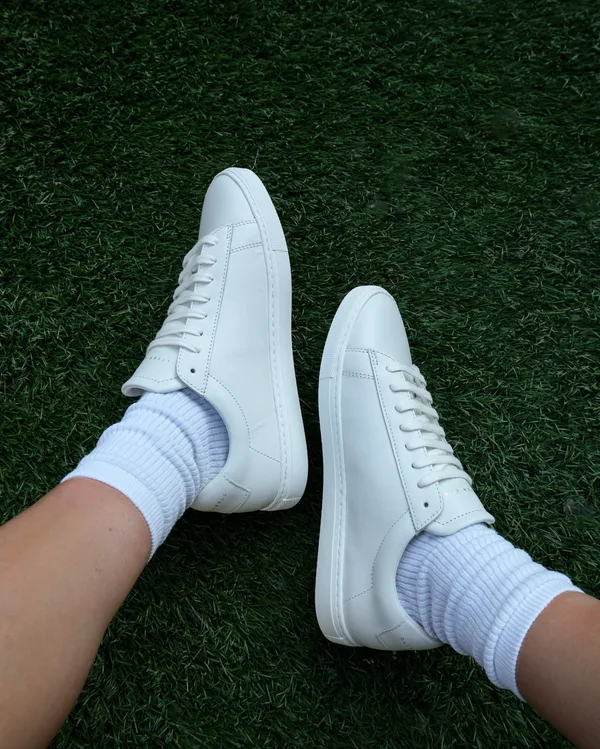
“The Perfect Sneaker Does Exist”
Why it works
The camera looks straight down at two white sneakers and white crew socks on dark green turf, so the viewer sees the shoe from the wearer's own angle. The contrast does the stopping. The proof a photo can't give sits in the body: Italian leather, an organic cotton lining and a build for "long days and light layers." A wearer's-eye view with no text on the picture opens the argument for the longest run here.
Started 12 Dec 2025. Live when checked on 25 Oct 2026. View in Meta Ad Library ↗
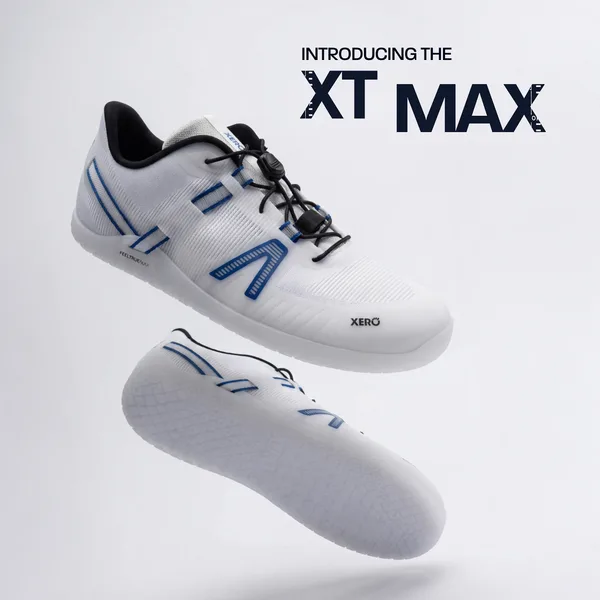
“New Arrivals: XT Max Workout Shoe”
Why it works
Two shoes float in a pale studio: the upper tilts toward the camera and the outsole turns to face up, under "INTRODUCING THE XT MAX" in bold type. The sole is the argument here, because the body says the shoe removes excess cushioning, and the picture lets a viewer see the whole outsole. Floating the pair makes both the upper and the outsole readable without a model.
Started 27 May 2026. Live when checked on 25 Oct 2026. View in Meta Ad Library ↗
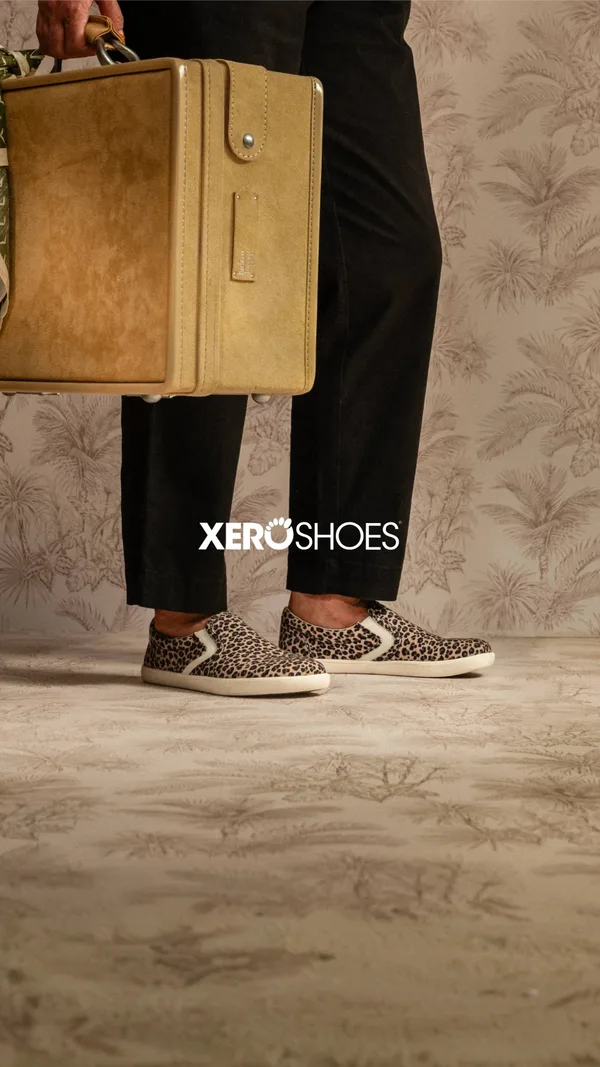
“Move Naturally”
Why it works
Only legs and feet appear: a person in dark pants carries a gold suitcase across a palm-print wallpaper, wearing leopard-print slip-ons, with the Xero Shoes logo laid over the pants. A barefoot-style shoe is placed in a travel scene, not a gym. The headline and the body about animal print favorites do the rest. Use a tight crop when the print is the product.
Started 24 Jun 2026. Live when checked on 25 Oct 2026. View in Meta Ad Library ↗
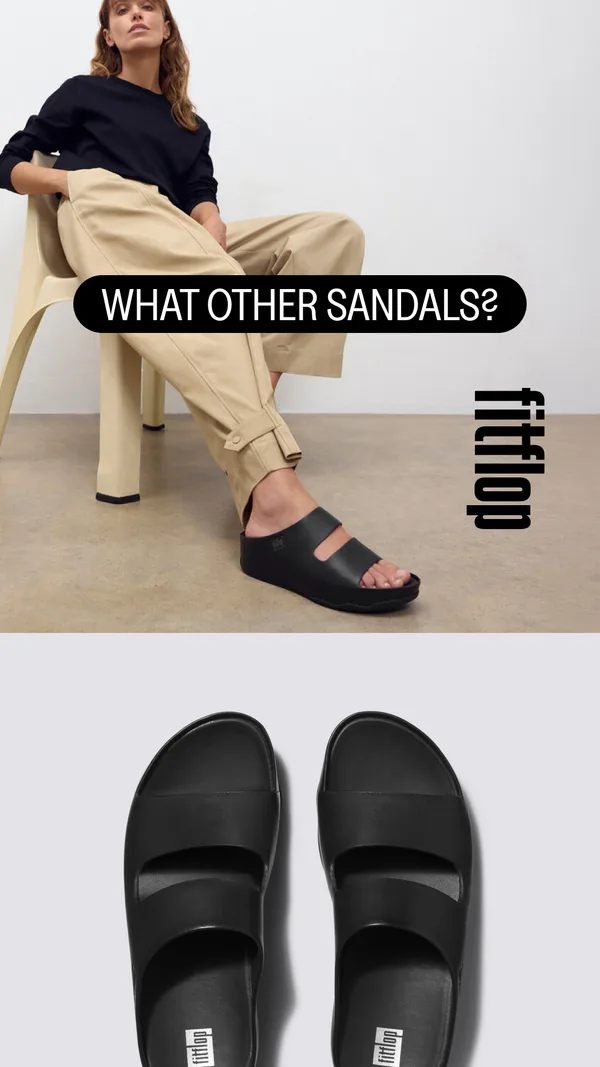
“WHAT OTHER SANDALS?”
Why it works
A woman sits on a pale plastic chair in cream pants and a chunky black sandal, with "WHAT OTHER SANDALS?" in a black pill across the picture, and the same sandal is shown top-down below. The question dares the viewer to name a rival, and the split gives a worn view and a clean product view in one frame. The long body leans on identity, "Defiantly comfortable with a couldn't-care-less aesthetic". Styling and shape arrive together, with no scroll between them.
Started 26 Jun 2026. Live when checked on 25 Oct 2026. View in Meta Ad Library ↗
“Comfort and style all day.”
Why it works
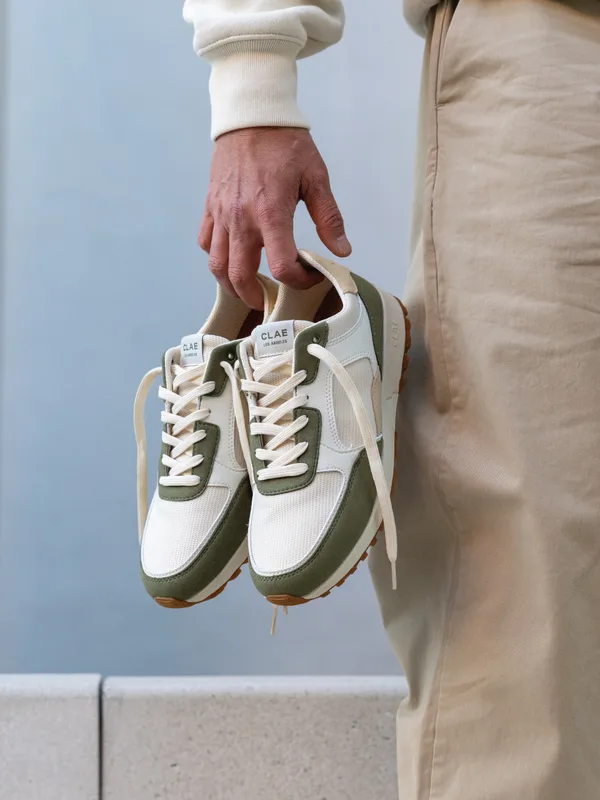
A hand holds a pair of olive-and-cream sneakers by the heels against a pale blue wall, beige pants and a cream sweatshirt cuff just in view. Nothing is written on the picture. The body promises "Comfort and style all day" and describes the pair as "always 100% vegan, crafted from upcycled, low-impact materials". Laces hang loose in the grip, a casual detail that reads as real life more than a shoot.
Started 8 Sep 2026. Live when checked on 25 Oct 2026. View in Meta Ad Library ↗
“Draw Your Own Line”
Why it works
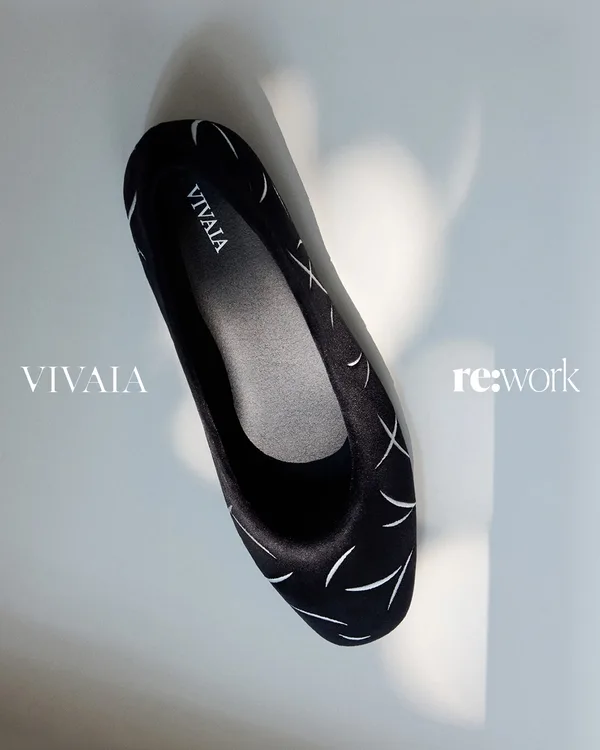
A single black velvet flat lies on a pale, shadowed surface, marked with white brush strokes, between the VIVAIA and re:work wordmarks. The copy, "Draw Your Own Line", frames the embroidery as self-expression, and the hashtags in the body tie it to workwear. With so little in the frame, the pattern on the velvet is the only claim.
Started 12 Sep 2026. Live when checked on 25 Oct 2026. View in Meta Ad Library ↗
Headlines that name the trip, the weather or the foot
Lifted from the ads above. Swap in your own product.
- 01The [Place] SneakerReef, “The Airport Sneaker”, 312 days
- 02Float over [the surface that stops you]Vessi, “Who likes wet socks?”, 116 days
- 03[Dress shoes] that feel like [sneakers]Amberjack, “World's Most Comfortable Dress Shoes”, 215 days
- 04More [benefit]. Less [worry].VIVAIA, “More Grip. Less Guesswork.”, 30 days
Putting proof inside a shoe ad
- Pick one place to wear itReef's airport, Vessi's cobblestones and Amberjack's dress code each give the shoe a single setting, which is easier to picture than a list of features.
- Answer one foot worryName the toe box, the grip or the arch as Oliver Cabell, HIKE Footwear and VIVAIA do, so the comfort claim attaches to a part of the shoe.
- Put proof on the pictureA badge, a press bar or a review count, as on Koio's, Amberjack's and Inkkas's ads, puts the verdict inside the image and not only in the body.
- Label every pair in a lineupThursday Boot Company gives each boot a model name, so the buyer can choose without opening a catalog.
- Back it with a promiseVessi's Dry Socks Promise and the free returns in Sole Bliss's copy take the fit risk off the shopper.
- Show it on a foot onceOne worn frame, like Tropicfeel's low shot or Sole Bliss's armchair picture, is the nearest thing to a fit check a photo can offer.
Sizes and Safe Zones are on our Instagram Safe Zone checker page.
Proving comfort off-camera
Parts and their jobs. Oliver Cabell's Low 1 pairs each part of the shoe with its job on the picture itself, with lines such as "Orthotic Insole For Heel & Arch Pain" and "Wide Toebox To Relieve Pressure & Soreness".
A comparison the buyer trusts. Amberjack's "Dress Shoes That Feel Like Sneakers" and FitFlop's "flats that don't make you miss your sneakers" explain comfort by pointing at a shoe the shopper already likes.
A promise on the risk. Vessi offers a Dry Socks Promise in its body copy, and Sole Bliss and Thursday Boot Company both list free returns, so the fit risk is shared.
Reviews and awards. Thursday's headline carries "125,000+ 5-Star Reviews", Inkkas's banner shows "10,000+ 5-STAR REVIEWS" and Amberjack shows two Forbes Vetted badges. The FTC's Endorsement Guides (16 CFR Part 255) set the rules for using reviews, awards and endorsements in advertising, and a brand has to be able to back what it shows.
Source: ecfr.gov
Naming the foot problem
The rule. Meta's ad standards limit ads that assert or imply a person's personal attributes, which include health conditions, so an ad that raises a condition has to be worded with care. Read the personal attributes section of the standards before naming one.
The shoe carries the condition. Sole Bliss puts it in the description of the product: "Shoes for Bunions, Wide Feet and Sensitive Soles", with the condition attached to the shoe category rather than to the reader.
One problem, one component. Oliver Cabell ties a wide toe box to "Pressure & Soreness" and an orthotic insole to "Heel & Arch Pain", so each problem is attached to a single part of the shoe.
Source: transparency.meta.com
Shoe ad questions, from fit to forecast
How to advertise for shoes?
Give each ad one checkable reason to believe the shoe is comfortable, such as a trip, a weather promise, a named part or a badge, and let the picture handle the styling. Vessi's "Float over cobblestones" pairs a waterproof claim with a Dry Socks Promise, and Oliver Cabell prints a benefit beside each part of the shoe.
What are some of the best sneaker ad campaigns?
Among the sneaker ads here, the ones tied to a trip or a verdict sit near the top of the run lengths. Reef's "The Airport Sneaker" ran 312 days, Koio's "Travel Sneaker of the Year" ran 269 and Koio's press-bar ad ran 247, though a long run shows spend, not sales.
Should a shoe ad show the shoe being worn?
Yes, in at least one version, because a foot in the frame is the nearest a photo gets to a fit check. About 30% of these ads are lifestyle shots with a person in them, such as Tropicfeel's low shot on dirt or Sole Bliss's seated model, but studio pictures like Koio's top-down pair ran long too.
Do shoe ads need a discount code?
No, though an offer can sit beside the story. Oliver Cabell, Reef and Koio ran 247 days or more with no code, while Tropicfeel's "Season's End Specials" carried up to 30% off for 314 days.
Can one ad show a whole shoe range?
Yes, if every pair carries its name. Thursday Boot Company's labeled lineups, with a model name beside each boot, each ran 201 days, and the labels let a buyer ask for the Explorer or the Captain by name.
Make shoe ads like these
Pick the one thing a shopper can check, whether a trip, a spec or a badge, then build each ad around it for your client's website or your own.
How we pick ads. We search Meta's public Ad Library for ads from DTC brands that sell to US and UK shoppers, keep ads running 14 days or more, skip catalogue ads, and show at most 3 per brand. Days running is a spend signal: brands rarely keep paying for an ad that doesn't sell. Day counts are as of the check date above. Breakdowns are written by Gimme Gimme's ad analysis engine from each ad's image and copy, and edited by Josh Jackson, founder. Not affiliated with the brands shown; ads appear for commentary and analysis. To have an ad removed, email hello@getgimmegimme.com and we'll take it down within 7 days.